
.png)
Newsletter N°88 - April 2026
🤖 Robotics: JAL and GMO launch humanoid robotics trial at Haneda Airport to automate ground handling operations
Japan Airlines (JAL), together with JAL Ground Service and GMO AI & Robotics (GMO AIR), has announced the launch of a proof-of-concept project to deploy humanoid robots for ground handling operations at Haneda Airport. The trial, which will begin in May, aims to progressively test the use of robotics to automate labor-intensive airport processes, with a focus on container transport tasks. The project is scheduled to run through 2028 as part of a phased development approach.
The initiative will initially focus on partial automation of container movement operations, including tasks such as container rotation, stopper release, and transport between ground service equipment (GSE) and high-lift loaders. These processes are currently performed manually and involve physically demanding actions such as operating heavy levers, pushing containers, and controlling wheeled dollies.
Two humanoid robot models will be used in the trial: Unitree “G1” and UBTECH “Walker E”. These robots have been selected for their human-like mobility and ability to operate in complex, constrained environments such as airport ramp areas, where a wide range of specialized vehicles and equipment must be handled in tight operational spaces.

Unitree "G1" (left) and UBTECH "Walker E" (right)

The Unitree "G1" was used for the demonstration this time.
A key rationale behind the project is the structural limitation of traditional automation solutions in airport ground operations. Unlike fixed infrastructure or task-specific robotics, humanoid robots are designed to operate within environments originally built for humans, potentially reducing the need for significant infrastructure modifications. This adaptability is seen as a key enabler for scalable deployment across multiple operational tasks in the future.
The project will be developed in stages over a three-year period, starting with individual task automation before progressing toward integrated sequences of operations. The development approach will combine imitation learning and reinforcement learning techniques to improve motion control, stability, and task execution in dynamic environments. Full autonomy is not the initial target, with the focus instead placed on incremental capability building and data collection in real operational settings.
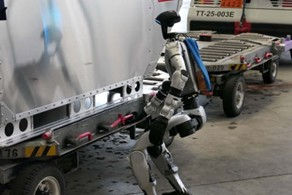
Image of the lever-raising process
GMO AIR was selected as a partner due to its integrated support model, security standards and ability to provide access to the latest robotic hardware through its deployment-oriented service structure. The company emphasized that rapid technological evolution in AI and robotics requires flexible development approaches and continuous iteration of both hardware and software systems.
From a strategic perspective, JAL positions the initiative as part of its broader “JAL Group Management Vision 2035,” which aims to establish a sustainable operational model through collaboration between human workers and technology. The airline highlighted that Japan’s aging population and labor shortages are increasing pressure on physically demanding airport roles, reinforcing the need for automation in ground operations.
GMO AIR described the initiative as a symbolic step toward the “social implementation” of humanoid robotics in real-world industrial environments, calling 2026 a potential “year zero” for humanoid deployment in Japan. The company also emphasized its broader robotics strategy, which includes humanoid deployment services and dedicated development facilities aimed at accelerating commercialization.