
.png)
Newsletter N°85 - January 2026
🧠AI Regulation: South Korea’s AI Basic Act Takes Effect: A Global First
South Korea has formally implemented the AI Basic Act as of 22 January 2026, establishing what authorities describe as the world’s first comprehensive legal framework to govern artificial intelligence, ahead of other major jurisdictions such as the European Union, whose own AI Act is being phased in through 2027.
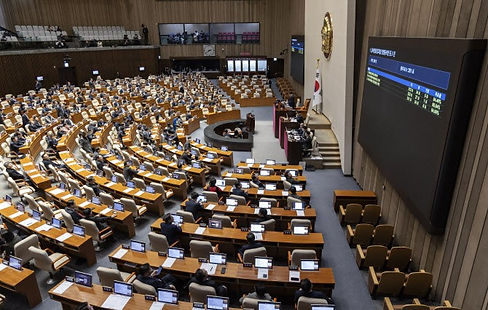
South Korea’s National Assembly chamber in Seoul. The AI Basic Act, the country’s first comprehensive AI regulatory framework, was passed here before entering into force in January 2026.
Promoted by the Ministry of Science and ICT as a balance between innovation and safety, the Act introduces baseline safety and transparency obligations for AI systems, especially those categorized as “high-impact”, defined as technologies with significant potential to affect public safety, human rights, or essential services such as healthcare, transport, and critical infrastructure. Companies deploying such systems are required to ensure meaningful human oversight and to implement risk management strategies.
Under the law, generative AI outputs that may be hard to distinguish from reality must be clearly labeled or watermarked, and users must be notified when interacting with AI systems. Enforcement includes a grace period of at least one year before penalties, which can reach up to approximately 30 million won (around US$20,400), are imposed, reflecting a compliance-oriented approach.
The Act also signals a shift from voluntary principles to enforceable obligations for AI developers and service providers, including multinational companies meeting certain revenue or usage thresholds, which may be required to designate local representatives for compliance purposes.
Promulgated in December 2024 and scheduled to take effect in January 2026, the AI Basic Act was drafted after extensive consultations with industry and expert stakeholders and is designed to foster both public trust and industrial competitiveness in the rapidly evolving AI space.
While the law aims to support AI growth, including national plans for R&D, infrastructure, and talent development, industry voices have raised concerns about vague provisions and potential compliance burdens for startups and SMEs, particularly where definitions such as “high-impact AI” remain subject to detailed enforcement decrees.
The introduction of the AI Basic Act places South Korea alongside, and in some respects ahead of, global peers in operational AI regulation, seeking to set baselines for transparency, accountability and safety while still enabling innovation and economic development.